See these folders? They all have picture files to help me pull random stuff out of nowhere. And then I usually play online and can screen-share with the PCs' players.
When I need a random monster, I turn to my encounters folder, which has a 1,001 pictures of monsters. Some banal encounters too!
When the players want to hexcrawl, I got images for that too.
Dressing is the folder I fill with odd underworld locations. Crazy rooms and decor.
I still usually use my MMoA catalog for treasure though.
The images for these folders usually come from my tumblr.
Now my question for any Mac geniuses out there: Does anyone know how to automate a process to open a random file in a folder? That would rock.
EDIT: +Ed Heil has come up with the best solution so far. I just punch one of these lines into my Console app:
ruby -e 'system("open", Dir[ENV["HOME"]+"/Desktop/Encounters/*"].choice)'
ruby -e 'system("open", Dir[ENV["HOME"]+"/Desktop/hexcrawl/*"].choice)'
ruby -e 'system("open", Dir[ENV["HOME"]+"/Desktop/dressing/*"].choice)'
ruby -e 'system("open", Dir[ENV["HOME"]+"/Desktop/treasure/*"].choice)'
If you end up trying this and it doesn't work for you, you might be able to do it by substituting the word "sample" for choice.
In any case, those lines are easy to pop individually into a shellscript in Automator. Saved as apps, these things are now just a double click away from providing me with goodies.
----
Want to give feedback? Share this on g+ and give me a tag (+claytonian JP) (if you want to keep it private, share with only me).
If you spot a typo or don't have g+, you can just email me. Claytonian at the gmails.
Friday, May 3, 2013
Wednesday, May 1, 2013
Barony RPG Quick Start Guide
This is a little primer I am putting together to help my players as we tackle a one-shot adventure with pre-made characters. I think it will be quick to jump into. The wording is my take on Barony: Rogue Swords of the Empire.
Well, if you have a trait or skill written on your sheet and there is little resistance, we will probably just narrate our way through it. If you don't, or the situation is a bit dramatic, roll 2d8. 2d8 is what we roll for everything. We then compare what you rolled to the action roll table.
Difficulty degree: The GM will tell you if the thing you are attempting is simple, difficult, tasking, or the limit of your abilities. Limit is reserved for occasions when the attempted use of a skill defies credibility or strains the boundaries of what would normally be accepted.
If you are attempting to do something that belongs to a skill you don't have, the degree goes up by two, but you can't attempt a skill you don't have if it would be tasking or limit before this raising. In other words, simple or difficult checks, that then get harder, only.
One roll per attempt (no rolling 3 times and hoping one of them succeeds, for instance).
Spells are not skills or abilities, but actions. Anyone can attempt them. I'll describe the process later.
Whatever you roll, there is a chance something bad (mixed or mishap) or too good (overkill) could happen. So be cautious if you are close to death or whatever.
Barony characters have virtually no numbers associated with them. Instead, you have attributes/traits and skills. Attributes are basic character traits and abilities. They do not confer specific maneuvers though. Here are the traits descriptors:
Artful: poise and finesse; comely, articulate, sure-footed and deft of hand
Bold: seemingly invincible, unyielding and without fear
Clever: resourceful, inventive and shrewd; traits of scheming, snap decisions, etc.
Durable: exceptional size, strength and/or endurance.
Eldritch: attuned to ambient mystic forces [magic use unrelated though]
Fast: superior reflexes and speedy movements, quick reactions
So, in general, improvise off of the above stated qualities. There are some actual game mechanics too:
Bold: Ignore battle pain (don't lose actions to pain, or take penalties from damage).
Fast: Can make two dodge actions during a response phase of combat, provided they have a skill or want to do a harder roll, then take the best result of the two.
Attributes also add extra eponymous wound boxes (there are no hit-points in Barony, only wounds).
Skills have many different uses. Basically whatever you imagine. I'll cover the combat applications in the combat section below.
Classes unlock skills when leveling up, but keep in mind they also add eponymous wound boxes.
Combat is divided into the Advantage (any PCs that want to act first and viciously), Opposition (enemy attacks and spells), and Response phases (PCs that wait this long have a chance to block with a skill or counter a spell). You act during one of the the PC phases once per round. No initiative rolling is done.
Some skills that come up in combat (they have different difficulties), and possible goals (don't let yourself get limited) to roll them (hope they roll high!) follow:
Luck, speed and guile, or mastery of shield: blocking skills (blocks without one of these will be two more degrees harder).
Animal Reflexes: (response phase) reduce level of one wound taken this round and inflict bruise/cut
Battle Cry: Inspire self and companions with a bonus until next turn
Battle Hard: Ignore bleeder wounds for a round
Berserk: Bonus to attacks, ignore pain
Brawl: (advantage phase) lock down an opponent, or try to stun 1d8 dudes
Concentration: (response phase) deal more deadly wounds next round
Distraction: Enemies that try to hurt you take damage
Foul Blow: (advantage phase) rob a humanoid of their attack this round
Hero's Great Weapon: (advantage) inflict a bleeder, or (either phase) inflict a bruise/cut
Irregular Blow: (either) bruise/cut, or (response) bleeder
Leveraged attack: (either) bruise/cut, or (adv) vicious, or (resp) bleeder.
Quick Blows: Make 1d8 attacks during next advantage phase!
Ranged power blow: bruise/cut from a stone's throw away. If you get a mixed result, only adv deals damage
Ranged Precision Hit: bleeder across the battlefield, but mixed result only hits during adv
Strength of Limb: Lock down an opponent
Warrior's Sidearm: Inflict bruise/cut
Wrist Speed: Try to draw and attack in same round
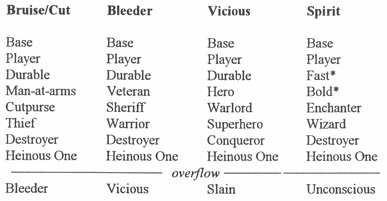
Monsters die when they run out of words in their wounds. Same deal for you, actually. But most wounds will be bruise/cut and then when you run out of words in that category the next (bleeder) will start to go down. Vicious are the worst physical wounds. Spirit wounds are rare, but hardest to get back...
Below is a table of possible wounds. You get any words that appear on your character sheet, and ignore the rest. Everyone gets Base and Player wounds.
If you are sure you want to take the risk, tell the DM what you want to do and they will determine how many laws you are breaking to determine the number of action rolls and their difficulties. The laws of Barony physics are:
I (energy/forces): Force flows through fixed channels; natural forces are immutable.
II (matter/identity): Everything is a precise, immutable blend of elemental earth, air, fire, and water (or humors).
III (spirit): Consciousness is a phenomenon controlled by something unique and untamed outside of nature that manifests in one spot (the brain).
IV (space-time): Planes of existence are distinct, separate, unmixed, and don't cross.
V (knowledge/unknown): Past events are immutable in our memories, and some things are not meant to be understood.
You can break any law(s) with magic, but know that doing the same spell more than once, ever, will make it harder in degree. This is the zeroth law of originality.
You can counter a spell, if you haven't acted yet, during the response phase. Unfortunately, if multiple laws were broken, you'll have to counter each violation, but it is easier to counter than to cast.
Wizard duels are things PCs can initiate too, but you don't cast spells; you just both kinda do kamehamehas until one gets knocked out. targeting magic point-lacking targets creates feedback!
The skill Magic Immunity can potentially cancel out harmful magics in an area...
Gotta do some crazy things called ignobles. The DM will go through the list when an adventure ends.
With a roll! Starting classes are associated with resource levels. Based on the result when you go to check your coffers, you may be out of funds...
*:coin is the plural in Barony
----
Want to give feedback? Share this on g+ and give me a tag (+claytonian JP) (if you want to keep it private, share with only me).
If you spot a typo or don't have g+, you can just email me. Claytonian at the gmails.
How do I do all the things?
Difficulty degree: The GM will tell you if the thing you are attempting is simple, difficult, tasking, or the limit of your abilities. Limit is reserved for occasions when the attempted use of a skill defies credibility or strains the boundaries of what would normally be accepted.
If you are attempting to do something that belongs to a skill you don't have, the degree goes up by two, but you can't attempt a skill you don't have if it would be tasking or limit before this raising. In other words, simple or difficult checks, that then get harder, only.
One roll per attempt (no rolling 3 times and hoping one of them succeeds, for instance).
Spells are not skills or abilities, but actions. Anyone can attempt them. I'll describe the process later.
Whatever you roll, there is a chance something bad (mixed or mishap) or too good (overkill) could happen. So be cautious if you are close to death or whatever.
What are these words on my character sheet?
Artful: poise and finesse; comely, articulate, sure-footed and deft of hand
Bold: seemingly invincible, unyielding and without fear
Clever: resourceful, inventive and shrewd; traits of scheming, snap decisions, etc.
Durable: exceptional size, strength and/or endurance.
Eldritch: attuned to ambient mystic forces [magic use unrelated though]
Fast: superior reflexes and speedy movements, quick reactions
So, in general, improvise off of the above stated qualities. There are some actual game mechanics too:
Bold: Ignore battle pain (don't lose actions to pain, or take penalties from damage).
Fast: Can make two dodge actions during a response phase of combat, provided they have a skill or want to do a harder roll, then take the best result of the two.
Attributes also add extra eponymous wound boxes (there are no hit-points in Barony, only wounds).
Skills have many different uses. Basically whatever you imagine. I'll cover the combat applications in the combat section below.
Classes unlock skills when leveling up, but keep in mind they also add eponymous wound boxes.
How do I kill KILL KILL?
Some skills that come up in combat (they have different difficulties), and possible goals (don't let yourself get limited) to roll them (hope they roll high!) follow:
Luck, speed and guile, or mastery of shield: blocking skills (blocks without one of these will be two more degrees harder).
Animal Reflexes: (response phase) reduce level of one wound taken this round and inflict bruise/cut
Battle Cry: Inspire self and companions with a bonus until next turn
Battle Hard: Ignore bleeder wounds for a round
Berserk: Bonus to attacks, ignore pain
Brawl: (advantage phase) lock down an opponent, or try to stun 1d8 dudes
Concentration: (response phase) deal more deadly wounds next round
Distraction: Enemies that try to hurt you take damage
Foul Blow: (advantage phase) rob a humanoid of their attack this round
Hero's Great Weapon: (advantage) inflict a bleeder, or (either phase) inflict a bruise/cut
Irregular Blow: (either) bruise/cut, or (response) bleeder
Leveraged attack: (either) bruise/cut, or (adv) vicious, or (resp) bleeder.
Quick Blows: Make 1d8 attacks during next advantage phase!
Ranged power blow: bruise/cut from a stone's throw away. If you get a mixed result, only adv deals damage
Ranged Precision Hit: bleeder across the battlefield, but mixed result only hits during adv
Strength of Limb: Lock down an opponent
Warrior's Sidearm: Inflict bruise/cut
Wrist Speed: Try to draw and attack in same round
Monsters die when they run out of words in their wounds. Same deal for you, actually. But most wounds will be bruise/cut and then when you run out of words in that category the next (bleeder) will start to go down. Vicious are the worst physical wounds. Spirit wounds are rare, but hardest to get back...
Below is a table of possible wounds. You get any words that appear on your character sheet, and ignore the rest. Everyone gets Base and Player wounds.
How do I magic it up?
Anyone can cast magic, but be aware that you may use up pieces of your spirit (health) doing so. Most characters have at least one or two magic points to buffer this though. Also, magic points (up to 4 per spell) can be used to give +1 bonuses to any one roll for it is rolled. Magic is usually intoned through incantations.If you are sure you want to take the risk, tell the DM what you want to do and they will determine how many laws you are breaking to determine the number of action rolls and their difficulties. The laws of Barony physics are:
I (energy/forces): Force flows through fixed channels; natural forces are immutable.
II (matter/identity): Everything is a precise, immutable blend of elemental earth, air, fire, and water (or humors).
III (spirit): Consciousness is a phenomenon controlled by something unique and untamed outside of nature that manifests in one spot (the brain).
IV (space-time): Planes of existence are distinct, separate, unmixed, and don't cross.
V (knowledge/unknown): Past events are immutable in our memories, and some things are not meant to be understood.
You can break any law(s) with magic, but know that doing the same spell more than once, ever, will make it harder in degree. This is the zeroth law of originality.
Spells sound cray-cray! How can I stop them?
Wizard duels are things PCs can initiate too, but you don't cast spells; you just both kinda do kamehamehas until one gets knocked out. targeting magic point-lacking targets creates feedback!
The skill Magic Immunity can potentially cancel out harmful magics in an area...
How do I level?
How do I spend my coin*?
*:coin is the plural in Barony
----
Want to give feedback? Share this on g+ and give me a tag (+claytonian JP) (if you want to keep it private, share with only me).
If you spot a typo or don't have g+, you can just email me. Claytonian at the gmails.
Friday, April 19, 2013
These Items are Your Character. Go!
A while back on g+ I ran a game where I made up the rules on the fly, because I was running Monolith Beyond Space and Time and rules take a back seat to player decisions in that one. I had the players all choose from one of the following collections of items. This became their character and its implied class. Basically it was generic d20 fantasy. Players rolled a hit die the first time they got damaged and so on.
Recently, I've encountered more than just the 4 original ones. If you go to this site, you can get a ton of them for a more modern campaign. You are the person with ababy! Go!
The Spagetti Western collection I found has to be approached a different way. I think the key to that one is to have players choose a character from the pictured ones.

----
Want to give feedback? Share this on g+ and give me a tag (+claytonian JP) (if you want to keep it private, share with only me).
I would love to know if anyone has created more images like these!
Wednesday, April 10, 2013
More Barony RPG Awesomeness
So, desperate as I am to get more of the Conrad's Fantasy/Barony/Free-style Roleplay RPG system, that I have ordered two issues of the defunct Space Gamer Fantasy Gamer. This was not cheap, as I live in Japan, but as far as RPGs as literature I am well pleased with my purchase.Issue #3, circa 1992 contains the following of interest to me:
Horrid, Rob Liefeld-inspired art. Well, he was pretty popular back then. Even adolescent, wanting to be a comic-book artist young me was tricked into liking Rob, though I was starting to question what the hell was up with his attempts at anatomy.
Anyways, the artwork accompanies the comic-book take at the Free-Style RPG system: Good Guys Finish Last. The interesting part is you actually play an entire comic book company. You and the other players control cool heroes too, of course. But the ignobles* and scenarios in this iteration of the system encourages you to pull publishing stunts with your story-lines and character deaths.
There is a scenario for the GGFL RPG in this issue too. Revolt in the East includes messing with timelines in both the Crisis on Infinite Earths sense and also as a thing imposed by someone who bought the comic company and decided to restructure the lines. It's a bit confusing, but sounds like it could be awesome if one pulls it off.
Which gets me thinking; an ambitious GM could make a campaign that reflects the true history of a comic company. Like the possibilities with making the DC universe come together from its disparate companies would be amazing. And super nerdy.
The horrible Liefeld aping is over most of the issue, but it is thankfully less obnoxious when it gets to the Barony scenario, which a classic dungeon delve, Grey Viper. There are unique monsters (crazy dead, gem-powered guardians, and waves of rats) and a Quick and Dirty† table for what happens when you fall into a room of vipers. You also get to see mention of the great Delta Zaire of character progression chart notoriety in the fiction that sets up the adventure. I want to run this.
The scenario for Era Ten (future iteration of the RPG) seems cool too. Very Aliens-esque space marines in setup, with the tantalizing finale of stealing items you need from your past self.
----
* :Ignobles are the experiences you need to level up in any Free-style system game.
†: Quick and Dirty is a term for random tables in the FSRPG systems. They even go as far as to ™ the term.
----
Want to give feedback? Share this on g+ and give me a tag (+claytonian JP) (if you want to keep it private, share with only me).
Saturday, March 30, 2013
How Barony was Dungeon World Before Dungeon World; a System Review
![]() | ||
| Durable is possibly the best choice if you want a shot at all the other abilities. |
The building blocks of your character are not numbers like ye olde "Strength 13" or "Social 3 dots" or whatever, they are called attributes (or traits) and they are key words that give you an talent or two and maybe a chance to get certain skills. So it's kind of like everybody has things that set them apart from the fold. The traits are: Artful, Bold, Clever, Durable, Eldritch, and Fast. You chose one to start your character, then roll a d8 and consult the table under each one of these abilities to see what other traits you get (they all have different tables). You can afterwards gain or lose abilities through play.
Skills based of the above come next. Well, kinda. You can only choose your skills after you decide what your Title (read: class) is. The starting titles are at the top of the following workflow chart of titles, which is one of the coolest character tree system things I've ever seen. Lookie/zoomie/clickie:
So, fer instance, if you choose to be a Footman, you will start with 3PCs. That is, 3 "Physical & Combat" category skills, but only if you have the prerequisite attribute(s) they demand (this is actually really simpler than I am making it out to be, I promise). One thing to keep in mind is that even if you don't have a skill for whatever reason, you can still attempt it at an increased difficulty. So to use a skill check the degree of difficulty in its description, adjust for things like if you don't actually have the skill etc, roll 2d8, and consult the following table.
And there you see how this is really like the Dungeon World of the late 80s/early90s. I like the Barony spread a bit more though, as a fail is usually not so bad and a fumble rare if you play smart. The Overkill result is cool too. The DM may say, "Intimidate him? Yeah, you do that, and he will remember your face for the rest of his life." Then draw up some craven revenge plans for the poor NPC.
Magic is not a skill, as anyone can attempt it, but classes will give you the Magic Points to help cast them (otherwise you may end up spending your soul to cast, but we'll get to that). Magic is freeform, with a couple of restrictions: (1)it gets harder the more physical laws you break, and (2) it gets harder to cast a spell that has ever been cast before. Forced creativity is why I love this system! Of course it is ripe for abuse too, being bounded only by imagination, but as the authors recommend, you could just take 5 minutes to roll up a new world if the PCs end it. Or just say, "Stop being a prick, Player X."
Attacking and defending is not a skill either, but these are rolled likes skills and maybe informed by them.
Okay, say you got your skills chosen (or rolled up randomly which would be faster). You are ready to do things! But if you fight something, you may get chunks of your being wiped out for a while. Look at this damage chart:
Everything will damage you in one of those 4 categories. Every character has the Base and Player rows or as I will call them, boxes (as the columns separate the rows) as well as maybe something from their attributes or title (see Durable up there?). Check the boxes off until you run out of them, then go down to the overflow section and follow that. So if you run out of Bruise/Cut boxes, you have to start crossing of Bleeder column boxes and so on. Spirit you may loose depending on how hard the magic you use is and how low your check ends up; most monsters leave it alone. The Bruise/cut boxes come back after a battle, the Bleeder and Vicious ones after an adventure, and Spirit only can be cured by magic, which may be a little too hard-core, I dunno.
Monsters have their own abilities and skills and damage charts with evocative keywords that help you give them metal names. Trust me, monsters are cool and easy to make in Barony. A wee bit like Dungeon World, once again.
So there are tons of skills, but I can't reproduce them all here, sorry. One interesting way skills and abilities get used is during events. Events are not man-to-man standard combat. Sample events given by the book include a bar brawl, fighting in a battlefield (mounted and unmounted and other things), and fighting a dragon. They use playing cards to randomise the montage that makes an event. For instance, in a bar brawl:
It's beautiful! Customize it towards the skills you know your players have if you want to give them a greater sense of awesome, or just revel in the fact that no rules lawyer can stop a Dark Lord from just getting knocked out or whatever. Fighting a dragon feels pretty epic when players have to survive until the event is over through scenes dependent on where they are in relation to the dragon, like this example if you draw a 2 while in the tail zone:
Combat can be pretty strategic, though simple. It has phases and some skills let you do cool things depending on the phase. As mentioned above, there is some mass combat if you want it. This game did have its roots in a wargaming magazine, after all.
It's hard to find much history online about this game. Heck, it's almost impossible to find the game, and rumor has it the creators are like Can't find it? Tough. A barely maintained (and riddled with 1970s-feeling English) website by the creators does give some clues as to how all started. Check out the history here, and you can click through some summaries of the unique qualities the game has here.
I've barely scratched the surface of this game. Between skills, magic, and events, things can get really deep. I can't recommend it enough!
----
Want to give feedback? Share this on g+ and give me a tag (+claytonian JP) (if you want to keep it private, share with only me). Also, maybe we can share ideas on how to get ahold of rare games like this. You can EMAIL me at claytonian at the gmails.
--
Edit: 1070s was my imagination I guess; can't find any evidence of when the system was truly first conceived.
Saturday, March 16, 2013
The Wandering Trees Resorces and Encounters (Awesome Forest Monsters for DCC)
The Wandering Trees is an old adventure from Dungeon Magazine (#67) that I re-purposed for a level 0 or 1 DCC Google+ group I run.I like the adventure, but it is a bit overcomplicated and ambiguous as presented in the magazine, so I have made a hex grid for it. The original adventure has paths that have a probability of disappearing that was very complex and expressed on a chart with letters and whatnot that takes a bit of time to reference.
Instead, roll a d6 every time the players encounter a possible path or if they have traveled on a path for long in terms of hexes or time. On a 3 or better, any paths in the area will show up. If they are on a path when they cross a hex, roll to see if it disappears around them. Hex crossing is a good time to make an encounters check too.
You can click the map to zoom in and download it. Also, you can see how we use a shared Google doc to map out the paths the players have discovered here.
I made custom DCC encounters for this place too:
With a hex grid, it was easier to tell when I should make rolls for random encounters (1 in 6 chance each day and for each watch of the night, plus an additional chance for each hex crossed, doubling if there is no random path granted by those willy trees). Here is the table I was using (has my attempts to make up interesting DCC stats for level one threats before the rules were finally published). In retrospect, I would roll 1d6 for number of monsters encountered each time it wasn't specifically listed; my players somehow just kept not properly dying. Otherwise, I am satisfied with myself for some of the odd crits and powers sprinkled throughout here.
| 1 | Wood Elf Stalkers from the local wood elf community. Very Quiet. Will attempt to stab and grab. They hate kobolds, and know their scent. Treasure: Natural material daggers, skins, elf bread.
|
| 2 | Kobold traders from the hills. Kobolds are mischievous cave fey that will try to barter for gemstones, gold, or cobalt. Negotiations may break down unless the players could really use some cave creature regents such as umber-hulk juice. They attack dwarves and wood elves on site. Treasure: Besides 1d10 worth of gems, A battery pack for a robot. They don't know its significance, but like the LED readouts.
|
| 3 | A unicorn. It will attack any amoral characters that sport furs, but if the PCs are gooduns, it will lead the way to a grove that is safe for the night.
|
| 4 | A pair of wolves. They are hungry, but run from pain or fire. One of them used to be a man and is slightly larger as he was cursed by a bog-witch. He will stalk the group from afar after they are first encountered if he has been driven off.
|
| 5 |
A shambling moss monster desires arcane knowledge and likes a little dismemberment too.
Treasure: Kept in a nearby cave is a collection of sorcerer bones and some tomes (can learn 1d3 spells at the next leveling up with study).
|
| 6 |
A small barghest (lycanthropic goblinoid) and three hobgoblins on a pilgrimage to defile the Great Oak Tree in the name of urban squalor. The barghest is in his mundane form, but mutters something about “you wouldn’t like me when I’m angry” if PCs get cheeky.
Treasure: Barghest bile goes for a good price in the right alchemist's shop. Also, a ring worth 23 sp that has the image of a goblinoid god.
|
| 7 |
A lake/pond/river haunt that attempts to garrote with soggy vines.
Treasure: nearby are the remains of victims with 1d12 in riches.
|
| 8 |
A man-eating tree that tries to take a chomp against someone leaning on it. Make a reflex save+ nature check mod or lose a digit/hand/arm. The tree cannot move, but no reason to let the players in on that until their panic has died down.
|
| 9 |
A Mossy walking skeleton that moans, “Beware the caiiiiirrrrnnns” but otherwise has no intelligence that can be accessed by mundane means. A ritual to speak with the dead may reveal more.
|
| 10 |
1d10 Will o’ Wisps or Japanese-style ghost lights (as appropriate for terrain) swarm in (1d5).
|
| 11 |
Obendar, a minor god of trees and vines. He knows about everything that happens in the forest, and call many things to his defense. He can only be compelled to speak by heroic PC deeds he has heard wind of or when threatened by certain species of tree-eating beetles which he has a phobia of.
Treasure: a wealth of spell regents (2d16 gp on the market).
|
| 12 |
Ensnaring vines try to choke 1d3 PCs. Make a reflex save or be grabbed by the neck. Damage as a garrote. These vines hiss and scream when cut (3 hp).
|
| 13 |
A vine-ensnared, slightly rusty robot at the foot of a tree. If investigated, a panel in the front will drop open.Any magical object placed within the revealed compartment will power the robot. The robot's temperament will match the alignment of the object. If its not evil, it will serve the PCs until it breaks its programming by learning about this thing you humans call love, or something.
|
| 14 |
A swordopus itching for a fight with land-lubbers.
|
I am satisfied with this table to a degree that I won't do the adventure's suggested swamp random encounters... unless I run through the whole table somehow. Then I'll scramble to stat a catoblepas.
There is also a green knight guarding the Southernmost bridge. He takes all challenges to single-combat and curses groups that try to overpower him with numbers or sorcery (curse: 50% chance of getting lost even if on a trail. Incidentally, the knight cannot die, but he is rather honorable and will yield if bested in single-combat. He does not pursue trespassers past the bridge. Uses hobgoblin stats cause I'm tired.
In the north swamp is a bog-witch that cursed her former lover to wander as a wolf until the treasure of the druids is found. Rolls a d30 for Charm and Polymorph effects.
Creatures of the forest not listed above :
Wereboar (pig form): Init +0; Atk charge +3 (1d4, critted targets are gored (1d5) and slowed); AC 13; HD 1d6; MV 11 Meters; Act 1d20; SP Regeneration 1d4 (recharges each turn w/a d6 roll; on a 5 or 6 as per 4e style recharge rules unless damaged by horns, teeth, or tusks); SV Fort +1 Ref +1 Will -1
Entling: Init -1; Atk slam +3 (1d5, crit: target gets an eye poked out unless they have goggles or a helm); AC 12; HD 1d8; MV 6 Meters; Act 1d18; SP animate entangling roots; SV Fort +1 Ref -1 Will +2
Phooka (humanoid form stats are as DCC beta kobold with a club) tree form: Init -1; Atk slam +3 (1d5, critted targets get an eye poked out unless they have goggles or a helm); AC 12; HD 1d6; MV 6 Meters; Act 1d18; SP only damaged by cold iron or magical attacks; SV Fort+1 Ref -1 Will +2
Pseudodragon: Init +0; Atk sting +2 (1d3 +save or 1d3 poison, lose a finger if you roll a 1); AC 12; HD 1d4; MV 7 Meters; Act 1d20; SP camouflage (+3 stealth); SV Fort -1 Ref +2 Will +0
Dryads: Init +1; Atk slam +2 (1d5); AC 13; HD 1d8; MV 10 Meters; Act 1d20; SP charm (will save or do what the dryad wants); SV Fort +2 Ref +0 Will +2
Giant Crayfish: Init +1; Atk claw +4 (1d5, grabs on a crit); AC 14; HD 2d8; MV 9 Meters; Act 1d20; SP— ; SV Fort +0 Ref +1 Will -3
Owlbear: Init +0; Atk claw +4 (1d8, blinds or KOs on a crit); AC 12; HD 3d8; MV 12 Meters; Act 1d20; SP —; SV Fort +2 Ref +1 Will -4
Upside-down-human-faced giant centipede (Chitter): Init +0; Atk bite +1 (1d3, save versus poison or become paralyzed) AC 12; HD 1d3; MV 6 Meters; Act 1d20; SP— ; SV Fort +0 Ref +0 Will -2
Slightly humanoid face-bearing giant spider (Mank): Init +2; Atk bite +3 (1d3, save versus poison or become paralyzed) AC 14; HD 1d6; MV 10 Meters; Act 1d20; SP Cast web (reflex save or immobilized) ; SV Fort +2 Ref +2 Will -2
Wraith (more interested in talking about silver keys than fighting): Init +0; Atk touch +3 (1d3 and player makes an attack at a companion ) AC 12; HD 1d6; MV 10 Meters; Act 1d20; SP can only be harmed by magical attacks or sunlight, torches do 1d2 dmg ; SV Fort +0 Ref +2 Will +2
----
Want to give feedback? Share this on g+ and give me a tag (+claytonian JP) (if you want to keep it private, share with only me).
Monday, March 11, 2013
Connections Will Make You a Better DM
Let's face it, DM's gotta make calls about what is happening or will happen that preserve the verisimilitude of a fantastic reality. One of the best ways to help with that is to have a vast wealth of knowledge of how things work. Reading is of course a good way, but for my money the best knowledge to time ratio may be found in the frames of Connections. The playlist below starts with the 8th episode of the 1st series, because it has some good information on polearms that will hit you square in the garygygaxes of your heart.
Obligitory links to series 2 and 3
Fun DCCish type jobs and suffering can be found in the frames of another series, The Worst Jobs in History. I don't like the production values or the host nearly as much as Connections, but it was still pretty fun and taught me all sorts of uses for urine.
This playlist starts in the Dark Ages episode.
Now that you got those series taking care of some of your trivial knowledge, you can devote your reading time to fantastic magic rules and monsters, like those presented in Tales of the Dying Earth
or Planet of Adventure
.
----
Want to give feedback? Share this on g+ and give me a tag (+claytonian JP) (if you want to keep it private, share with only me).
Obligitory links to series 2 and 3
Fun DCCish type jobs and suffering can be found in the frames of another series, The Worst Jobs in History. I don't like the production values or the host nearly as much as Connections, but it was still pretty fun and taught me all sorts of uses for urine.
This playlist starts in the Dark Ages episode.
Now that you got those series taking care of some of your trivial knowledge, you can devote your reading time to fantastic magic rules and monsters, like those presented in Tales of the Dying Earth
----
Want to give feedback? Share this on g+ and give me a tag (+claytonian JP) (if you want to keep it private, share with only me).
Subscribe to:
Posts (Atom)